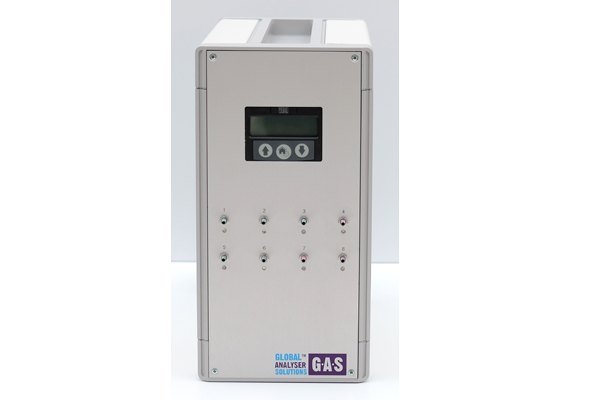

In modern catalyst research, process development, and pilot-scale testing, evaluating fast-changing gas compositions requires analytical instrumentation that is both remarkably swift and structurally resilient. Laboratories often operate with limited bench space while demanding continuous, unattended analysis over extended periods. To directly address these demanding parameters, the GAS Catalysis Reaction Gas Analyser utilizes up to four parallel analytical channels working simultaneously to separate and quantify permanent gases, hydrocarbons, aromatics, oxygenates, and trace sulfur species without interference.
The instrument features a programmable column oven powered by a low-mass nickel wire, providing incredibly rapid resistive heating rates of up to 500 °C/min. This unique architecture drastically cuts typical runtimes to under two minutes, with no additional conditioning required between runs. Furthermore, handling samples from low-pressure or small-volume pilot reactors is effortlessly managed via an advanced vacuum sampling capability that draws loops down to 4 mbar, requiring only 1 to 2 mL of actual sample gas. By combining highly durable diaphragm process valves with automated stream selection for monitoring multiple reactors, this system delivers an optimal return on investment through extreme flexibility and low operational costs.
Benefits
Ultra-Fast Results in Seconds: Leverages parallel multi-channel analysis to deliver complete, highly accurate gas compositions typically within less than 2 minutes, and frequently in mere seconds.
Highly Flexible Detector Configurations: Empowers researchers to perfectly match sensitivity and selectivity requirements by choosing from an extensive array of detectors, including TCD, FID, PFPD, PDD, ePD, MS, or VUV LUMA.
Compact and Robust Design: Features a space-saving 19-inch footprint integrated with heavy-duty diaphragm valves, guaranteeing reliable, fully unattended operation even in the most demanding laboratory environments.
Programmable and Exchangeable Columns: Allows for rapid method optimization through user-replaceable columns and advanced resistive heating technology capable of reaching temperatures at 500 °C/min.
Low Sample Volume Capability: Effectively analyzes gases from small-volume or low-pressure reactors by utilizing an intelligent vacuum sampling system requiring only 1 to 2 mL of sample.
| Category | Specification |
|---|---|
| Analyser Platform | 1-4 channel analyser based on GAS CompactGC4.0 |
| Detector Options | TCD, FID, PFPD, PDD, ePD, MS, and VUV LUMA PDA |
| Column Ovens | Isothermal or temperature programmed (rapid resistive heating up to 500 °C/min) |
| Sample Pathway | Completely inert Sulfinert® treated tubing |
| Sample Volume Requirement | 1 to 2 mL (via vacuum sampling option down to 4 mbar) |
| Analysis Runtime | Typically 2 minutes (depending on application) |
| Limit of Detection (LOD) | TCD < 5 ppm | FID < 0.1 ppm | PDD < 10 ppb | PFPD < 25 ppb | VUV LUMA < 50 ppb | MS < 1 ppb |
| Repeatability | < 1% RSD |
| Software System | Chromeleon and OpenLab |
Catalyst Performance Evaluation: Monitor reactants, intermediate products, and by-products in real-time to accurately determine catalyst stability, selectivity, and overall conversion efficiency.
Reaction Kinetics and Mechanism Studies: Seamlessly analyze rapidly changing gas compositions to actively support complex kinetic modeling and advanced reaction pathway research.
Pilot Plant and Laboratory Reactors: Execute continuous or semi-continuous monitoring of reactor outlet gases across widely varying experimental operating conditions.
Sulphur and Impurity Monitoring: Proactively protect valuable catalyst activity by reliably detecting microscopic traces of sulfur and other severe catalyst-poisoning components at ppb levels.
Multi-Reactor and Multi-Stream Analysis: Intelligently manage and analyze multiple distinct sampling points or independent reactors utilizing automated sequences and stream selector valves.
Catalytic Research Standards: The system is meticulously engineered to provide highly reproducible, real-time gas analysis data, ensuring rigorous compliance with stringent industrial and scientific quality requirements for advanced catalyst development, kinetic modeling, and pilot-scale testing.